| |||||||
|
Ambient vibration techniques are more and more widely used in monitoring of structures and systems. Recently this idea has distilled to the field of characterizing seismic effects of local building sites. The horizontal to vertical spectral ratio method (H/V) is a method to describe possible site effects. This method was introduced by Nakamura in 1989 and since then it has been widely applied in various forms and modifications to characterize local sites. In the mist of time the method became somewhat unclear and confusing as with new knowledge surfacing, many users bent it to their understanding and need. As originally conceived by Nakamura the H/V ratio is defined in the frame of estimating the transfer function of the surface layers. Later Nakamura extended the conception of H/V to the quasi-transfer spectrum (QTS), as preferably called by the author thereafter. Nakamura argues that in the range of the lowest proper frequency F of horizontal motion QTS shows a stable peak at this frequency, meaning that QTS represents the first order proper frequency due to multiple reflections of the SH-wave in the surface ground layer. When the microtremors of the base are sufficiently large the QTS also represents the resulting amplification factor of the surface ground layer, regardless of the excess of influence by Rayleigh waves. 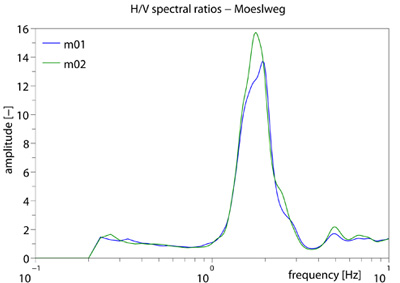 Since the introduction of the method the interpretation has shifted in some cases to the view that the peak of the H/V ratio can be explained with the fundamental peak of the Rayleigh waves. This conclusion was reached by various researchers (Lachet and Bard, 1994; Konno and Ohmachi, 1998; Bard, 1998) based on the study of Nogoshi and Igarashi from 1971. This view is generally accepted at the present, even though Nakamura refused it in 2000, supporting his refusal by a thoroughly explained argumentation. Once again he stated that the H/V peak is due to multi-reflections of the incident SH-wave. The Site EffectS assessment using AMbient Excitations - Sesame project was a major European undertaking to characterize local site effects based on ambient vibrations. The research done within the frame of this project was extensive and in-depth. The researchers of the Sesame group accepted a mixed view which is well described by Bonnefoy-Claudet as: „We then conclude that the origin of the H/V ratio peak is not unique and involves Rayleigh waves ellipticity, Love waves Airy phase, or the S-wave resonance. Nevertheless in all cases presented here, the H/V ratio peak frequency provides a good estimation of the resonance frequency.“ | |||||||
|
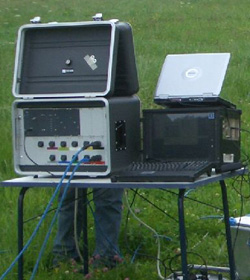
During our work we adopt the Sesame view of the problem. Our tasks regarding the method include its evaluation, testing and assessment of possible hardware, development of software and consequent application of the method to the city of Vienna. To reach an understanding of the method we conducted preliminary measurements and processed them by our own analysis software. Generally the H/V measurements are done by recording all three signals of a triaxial accelerometer by a data logger. The method relies on ambient microtremor as main input data, so that both horizontal components and the vertical one are used to yield the final spectral ratio curve. To reach a definite conclusion about the H/V method we selected different sites with extreme soil conditions. On one end it was a test inside a cave representing a rock site as opposed to some very soft soil sites on the other end. The preliminary tets prooved the feasibility of the H/V method in general. Its application to Viennese locations is ongoing. |
| ||||||
| |||||||